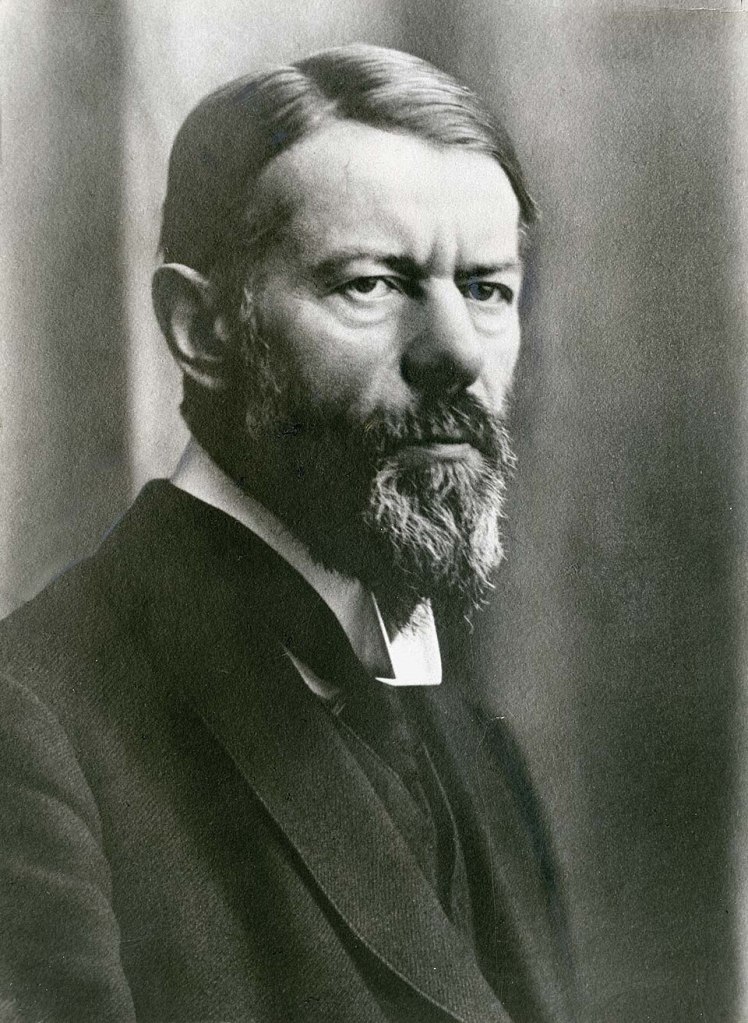
Max Weber (1864-1920), German sociologist and historian,
Capitalism did not appear everywhere at the same time. It did not take root with equal intensity in medieval Italy, Confucian China, Islamic North Africa, or Orthodox Russia. Instead, its most sustained and highly organized development occurred in places such as England, the Netherlands, Germany, and later the United States, societies deeply shaped by Protestant Christianity. Why was this the case?
This was the central question posed by the German sociologist Max Weber in his 1905 work, The Protestant Ethic and the Spirit of Capitalism. Weber did not argue that Protestants invented commerce, nor did he claim that greed was unique to Northern Europe. His argument was more nuanced and sociological. Certain Protestant doctrines, especially those associated with Calvinism, fostered patterns of disciplined and methodical behavior that aligned closely with the needs of modern capitalism. Over time, motivations that were originally religious solidified into social structures and attitudes that now influence even those who no longer hold the underlying beliefs.
From this perspective, capitalism is not simply an economic arrangement. It can be understood as the historical outcome of particular theological assumptions about human life and duty.
The Moral Economy Before the Reformation
To understand Weber’s thesis, it is important to consider the religious climate that preceded the Reformation. Medieval Christianity did not celebrate the pursuit of wealth. Riches were often viewed as spiritually risky, and profit-seeking could appear morally questionable. The Church prohibited usury and emphasized the concept of a just price. Commerce was allowed, but it was seldom honored as a moral calling.
Economic activity did not yet carry strong spiritual significance. People worked to survive and to fulfill social responsibilities, not to demonstrate signs of divine favor. There was no systematic theological encouragement of disciplined accumulation.
The issue, therefore, is not why people labored or traded before the Reformation, since such activities were constant features of human societies. The question is why economic life in certain Protestant regions developed a new intensity, regularity, and rational organization.
Calvinism and the Anxiety of Salvation
Weber located the turning point in theology, particularly in the reforms associated with John Calvin. Central to Calvinist doctrine was predestination, the belief that God had eternally chosen those who would be saved. This decision was unconditional and unchangeable. It could not be earned, influenced, or directly known.
Weber argued that this doctrine generated deep psychological tension. If salvation could not be secured through sacraments or good works, how could believers gain confidence that they belonged among the elect?
Although Calvinism maintained that works did not cause salvation, many believers sought outward signs of grace. A life marked by discipline, order, and moral seriousness could serve as indirect reassurance. Weber famously noted that the God of Calvinism required not isolated good deeds but a life organized into a consistent and unified pattern of moral conduct. Religion thus demanded coherence and sustained effort rather than occasional acts of piety. This transformation proved decisive.
This-Worldly Asceticism
Weber described the resulting lifestyle as this-worldly asceticism. Unlike monastic asceticism, which withdrew from ordinary economic activity, Protestant asceticism operated within everyday life. Believers were encouraged to work diligently in their calling, avoid idleness, resist unnecessary luxury, and treat time as a valuable resource. Income was not to be wasted on indulgence but carefully managed and, when possible, reinvested.
Within this framework, labor acquired new dignity. Faithful performance of one’s vocation became a form of obedience to God. Profit, if earned honestly and not spent extravagantly, could be interpreted as compatible with divine favor. Consumption was restrained not because wealth itself was inherently evil, but because excessive enjoyment threatened moral discipline.
The outcome was a pattern of life characterized by punctuality, calculation, and self-control. Economic behavior became steady and predictable. Religious self-examination gradually encouraged habits of planning, bookkeeping, and reinvestment, habits that would later support large-scale capitalist enterprise.
The Spirit of Capitalism
Weber distinguished ordinary greed from what he called the spirit of capitalism. Greed is universal and episodic. The capitalist spirit, by contrast, involves a systematic and rational pursuit of profit within a stable organization. It reflects sustained commitment to efficiency, expansion, and disciplined growth rather than occasional opportunism.
This outlook did not arise spontaneously. It developed within a moral framework that treated steady accumulation as meaningful and even obligatory. Protestant asceticism contributed to this framework by shaping individuals who valued hard work, long-term planning, and reinvestment over conspicuous consumption.
Religion did not intentionally create capitalism. Nevertheless, it cultivated a type of disciplined character that capitalism required. Weber’s broader insight is that ideas, once internalized as moral imperatives, can reshape everyday behavior. When such behavior becomes widespread, it solidifies into institutions that endure beyond their original motivations.
The Iron Cage
Weber’s analysis, however, is not celebratory. Once capitalism matured as a social system, it no longer depended on its religious foundations. The practices continued, while the theological justifications faded. What had begun as voluntary spiritual discipline gradually became an economic necessity.
Weber concluded with the image of the iron cage, or stahlhartes Gehäuse, to describe modern life within a rationalized and bureaucratic order. What earlier believers embraced as obedience to God has become an impersonal requirement of the system. As Weber observed, the Puritan wished to work in a calling; modern individuals often feel compelled to do so. The sense of obligation persists even when faith diminishes.
Modern Implications
Few people today affirm predestination in the precise terms articulated by Calvin. Yet work is still experienced as a moral duty. Productivity is admired, and idleness can produce guilt. Careers frequently become central to personal identity, while success is measured through efficiency, performance metrics, and continual improvement. Although the explicit religious language has faded, the disciplined structure of striving remains.
Institutions shaped by earlier moral commitments continue to influence expectations and patterns of reward. In this way, modern capitalism can be understood as a historical outgrowth of religious anthropology, an inheritance whose theological origins are often overlooked.
Conclusion
Capitalism did not arise solely from technological progress or universal human ambition. Nor did it develop uniformly across civilizations. Its most systematic form emerged in Protestant regions because particular theological doctrines encouraged distinctive patterns of disciplined life that aligned closely with rational economic organization.
Calvinism did not set out to produce capitalism. Yet—Weber says—in seeking assurance of salvation, believers cultivated habits of order, restraint, and sustained effort that proved transformative. Over time, these habits detached from their religious roots and became embedded within enduring economic
institutions.
Weber ultimately leaves readers with a challenging thought. We may still inhabit structures shaped by convictions that many no longer consciously affirm, guided by a moral history that continues to influence modern life even in the absence of explicit beliefs.
This article was researched and written by James Liu.

 THEONOMICA
Leave a comment